
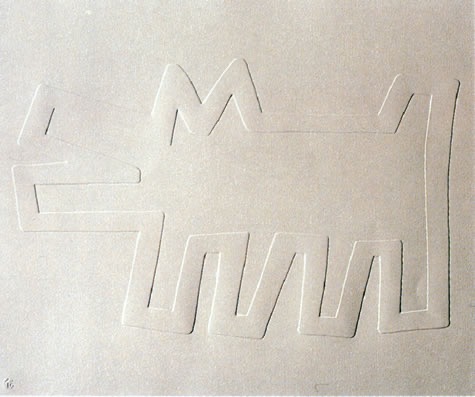
This beautiful and rare print is numbered hc 9/10
Framed dimensions are 78 x 68 cm (26.77″ x 30.7″)
| Medium | embossing on Arches Cover |
|---|---|
| Dimensions | 63,5 x 53,3 cm (21.5" x 25") |
| Year | 1990 |
| Edition | 10 h.c. |
| Details | Signed, dated and numbered to verso by Julia Gruen, Executive Director of the Keith Haring Foundation ‘hc 9/10 6/28/90’ with on the front an embossed stamp from the estate |
Out of stock
Keith Haring rose to prominence in 1980's New York within the East Village art scene alongside Jean-Michel Basquiat, Kenny Scharf, and Jenny Holzer. He bridged the gap between the art world and the street, graffiting city subways and sidewalks before committing to a studio practice. Haring united the appeal of cartoons with the raw energy of Art Brut artists such as Jean DuBuffet as he developed a distinct pop-graffiti aesthetic that comprised energetic, boldly outlined figures against solid or patterned backdrops.
This piece has been sold. Leave your email and we will keep you posted about similar and upcoming works.
every piece includes a Certificate of Authenticity (COA) and full provenance.
never rolled; always packed flat between protective board.
shipped fully insured via DHL Express or FedEx.
Edition numbers are assigned at the time of dispatch and may differ slightly from the number shown in product images.
Keith Haring’s Barking Dog embossed screen print from the White Icons series is a striking representation of the artist’s iconic style and his exploration of universal themes such as love, joy, and the human condition. Created in 1990, this artwork is part of a larger series of prints where Haring utilized white imagery against a black background, a departure from his usual vibrant and colorful palette.
The Barking Dog print features one of Haring’s most recognizable motifs—the playful and energetic dog. Rendered with dynamic lines and bold shapes, the dog exudes a sense of movement and vitality as it barks joyfully into the void. The use of embossing adds texture and depth to the print, allowing the dog to leap off the page and come to life in three dimensions.
Despite its simplicity, the Barking Dog print carries layers of meaning that resonate with viewers. Dogs often symbolize loyalty, companionship, and unconditional love, themes that were central to Haring’s artistic vision. By depicting the dog in mid-bark, Haring captures a moment of exuberance and spontaneity, inviting viewers to embrace the joy and vibrancy of life.
The White Icons series marked a departure from Haring’s earlier works, which were characterized by their bold colors and intricate patterns. In this series, Haring opted for a more minimalist approach, using white imagery against a black background to create a stark and striking contrast. This shift in style allowed Haring to explore new visual techniques while still maintaining the essence of his iconic imagery.
| Weight | 3 kg |
|---|
Keith Haring rose to prominence in 1980’s New York within the East Village art scene alongside Jean-Michel Basquiat, Kenny Scharf, and Jenny Holzer.
He bridged the gap between the art world and the street, graffiting city subways and sidewalks before committing to a studio practice. Haring united the appeal of cartoons with the raw energy of Art Brut artists such as Jean DuBuffet as he developed a distinct pop-graffiti aesthetic that comprised energetic, boldly outlined figures against solid or patterned backdrops. His major themes included exploitation, subjugation, drug abuse, and the threat of nuclear holocaust.
Haring boldly engaged with social issues, especially after receiving an AIDS diagnosis in 1987.
Today, his work sells for seven figures at auction and has been the subject of solo shows at the Brooklyn Museum, the San Francisco Museum of Modern Art, and the Albertina Museum in Vienna, among other institutions.
Subscribe to The Journal for periodic art notes and new arrival alerts,